Why Photographers Are Basically Just Computer Goblins
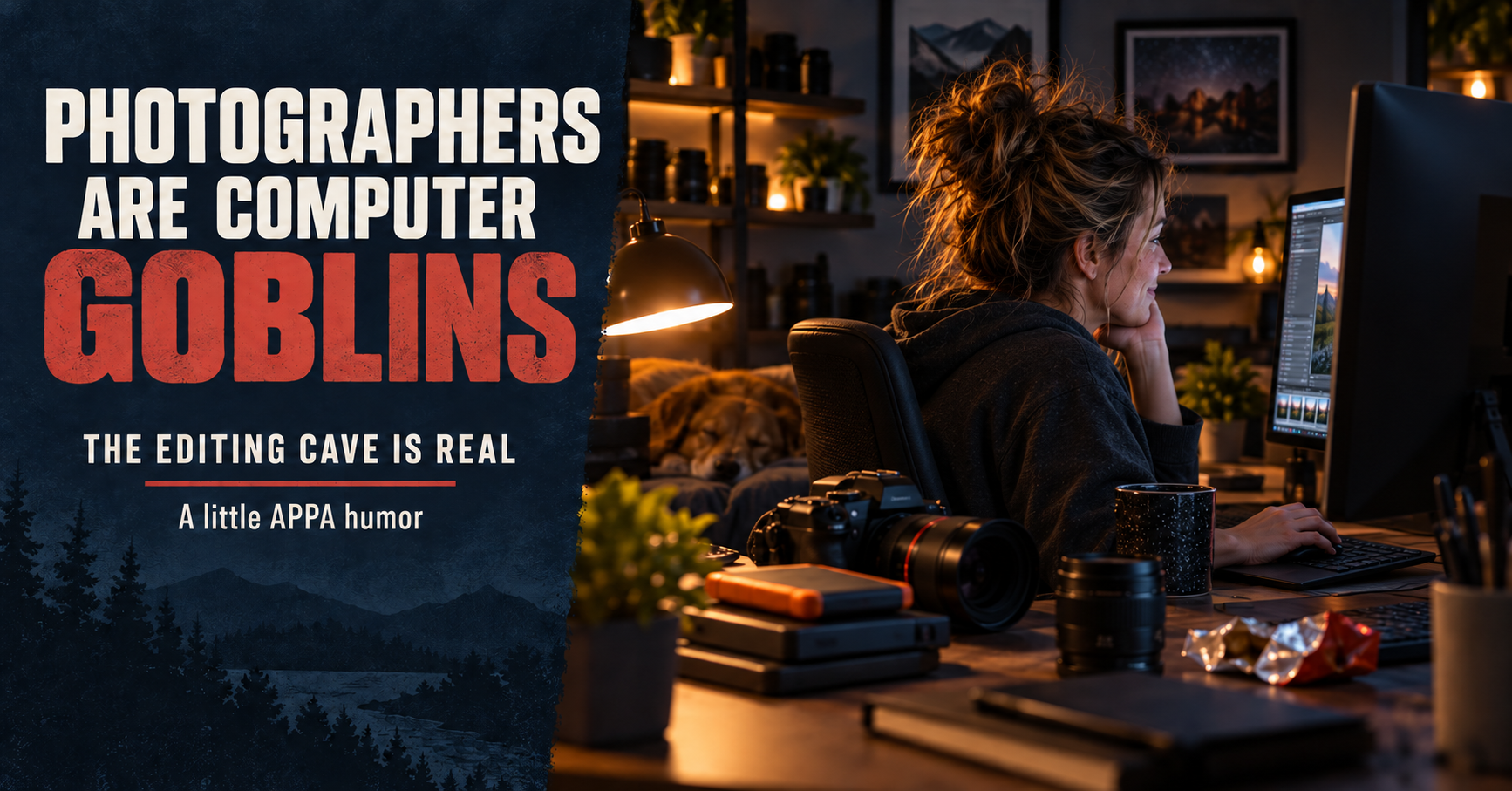
There is a lie the public has been sold about photographers.
They think we spend our days wandering through golden fields with a camera over one shoulder, gently whispering, “Perfect, beautiful, now look toward the light.” And sometimes, yes. We do that.
But that is only the glamorous 10 percent. Our public-facing persona.
The other 90 percent is spent sitting in a dark room, illuminated by the blue glow of Lightroom, surrounded by empty coffee cups, external hard drives, and the vague feeling that we should probably stand up before our spine files a formal complaint. The imminent snap, crackle, and pop the mental hurdle our feelings just are not looking forward to.
Welcome to the editing cave. The place where “my precious” was likely born.
Welcome to the goblin hours.
The editing lair
Every photographer has a version of it.
Maybe it is a beautiful studio office with calibrated monitors and a proper desk (hahahaha, who am I kidding). Maybe it is a kitchen table, a laptop balanced on three expired coupons and something sticky the kids left there last Halloween, and a chair that has become permanently shaped like your emotional support posture.
Either way, once you sit down, the transformation is immediate.
At the session, you are an artist. You are directing. You are finding light. You are making everyone feel comfortable. You are creating magic.
Then you get home, import 1,842 images, and become a small, feral creature who whispers things like:
“Why is the background so green?”
“Was that dog always in this picture?”
“Is this skin tone warm… or is my monitor lying to me again?”
“Just one more mask and it’ll be perfect.”
Three hours later, you have not eaten dinner, your cat is looking at you with contempt in it’s heart, you have edited the same image seventeen different ways, and you are 12 percent certain the client can actually tell the difference between the two versions you are comparing and you are stressed about it.
But you 100% can.
And that is the curse.
The sacred hoard of expensive hard drives
A goblin without a hoard is not a goblin.
Photographers, however, have a hoard.
It is made of hard drives.
There is the active drive. The backup drive. The backup-backup drive. The drive you bought “just in case.” The drive labeled “OLD STUFF—DO NOT DELETE,” which contains photos from 2012, four Lightroom catalogs, a folder called “FINAL_FINAL_FOR_REAL,” and at least one image of a blurry pigeon.
You cannot delete the pigeon. What if you need it?
You will not need it. You know this. Your family knows this. Your accountant probably knows this. But…still…
One day, someone may call and say, “Do you happen to have that slightly out-of-focus pigeon from a parking lot eight years ago?”
And you will be ready! (Oh, how I wish this would actually happen, who else needs that sense of validation???)
The 72-tab workflow
A photographer’s computer is not organized by ordinary human standards. There is organization, but can you explain your method?
There is Lightroom. There is Photoshop. There are three browser windows. One contains a printer-paper order. One contains a tutorial you opened six months ago. One contains an article titled “How to Be More Productive,” which you have not read because you have been busy reorganizing presets.
Then there are the tabs that no one can explain:
A weather forecast from a session last Tuesday
A camera review for a lens you do not need
A forum discussion from 2018
A shopping cart with $4,700 in gear
A YouTube video called “Five-Minute Editing Trick”
A second YouTube video called “Why Your Colors Look Bad”
A third YouTube video called “Stop Buying Gear”
That last one feels unnecessarily personal.
The language of the cave
Photographers speak fluent goblin-tech.
We say things like, “I need to calibrate my monitor because the export looks too warm in sRGB,” and everyone around us nods politely as if we have not just summoned a genie from the Department of Color Management.
We discuss ISO, shutter speed, compression, dynamic range, white balance, culling, masking, skin tones, smart previews, catalogs, and the emotional damage caused by an accidental crop sync.
To non-photographers, this sounds complicated.
To photographers, it sounds like a Tuesday.
Goblin hours: when creativity and deadlines collide
There is a particular time of night when the world gets quiet, the notifications slow down, the kids have crashed finally, and a photographer says the most dangerous sentence in the English language:
“I’m just going to finish a few edits.”
No one has ever finished “a few edits.” Ever.
A few edits becomes one more gallery. One more skin cleanup. One more background distraction. One more attempt to decide whether the crop is better at 4x5 or 2x3.
Suddenly it is 2:47 a.m. and the cat is STILL giving you that glare.
You are eating pretzels directly from the bag because using a bowl would create dishes, and dishes are a problem for daytime you.
You are on your fourth coffee, although it is absolutely no longer coffee-time by any reasonable definition. Reasonable… right?!?
And somewhere in the room, an external hard drive is blinking quietly—judging you, again.
The quest for shiny new gear
Every great goblin story must include a quest for treasure.
For photographers, treasure is gear.
A new camera body. A faster lens. A modifier with a name that sounds like an upgrade in a fantasy game. A tiny accessory that costs $189 and claims it will “revolutionize your workflow.” You need it!
You will spend three weeks researching it.
You will watch fourteen reviews.
You will compare it to another piece of equipment you already own.
You will ask three photographer friends what they think.
Then you will buy it, use it twice, and return to your favorite lens—the one that has been carrying the team since 2017.
Still, it is important to have options. That is what we tell ourselves.
Why APPA members understand
This is one of the best things about being part of a photography community: you do not have to explain the goblin behavior. You are not judged.
We APPA members understand why you have backup drives. They understand the terror of a corrupted card, the satisfaction of a perfect edit, the strange confidence boost of a clean Lightroom catalog, and the fact that “I’ll send the gallery tomorrow” can be a perfectly reasonable sentence—even if it is already technically tomorrow.
They understand the work behind the work.
And when your editing cave starts to feel a little too cave-like, they are also the people who can offer advice, share a workflow, recommend a solution, or simply remind you that you are not the only person who has ever stared at a monitor and wondered why one photo is suddenly magenta.
Embrace your inner goblin
So yes, photographers are basically just computer goblins.
We hide in our editing caves. We guard our hard-drive hoards. We speak in strange technical language. We stay up too late chasing tiny details that nobody else may ever notice.
But from all that strange, caffeinated, late-night effort comes something meaningful.
We create photographs that hold people’s memories. We preserve stories. We give families images they will keep. We make art from ordinary moments.
That is pretty magical work for a bunch of goblins.
Just do not touch the hard drives!
Written by Donnie Wayne Smith (with some organizational help from ChatGPT) : )